Test Generation Overview
This document provides a high-level overview of how Pynguin’s test generation works. It covers the key components and processes involved in generating test cases for Python modules.
Genetic Algorithms for Test Generation
To get an conceptual overview of Genetic Algorithms and Search Based Software Testing take a look at the SBSE 2024 repository. In particular, the following Jupyter notebooks on search-based test generation might be of interest:
Search-Based Test Generation - Part 1: Introduction to search-based test generation
Search-Based Test Generation - Part 2: Advanced topics in search-based test generation
Pynguin’s Test Generation Process
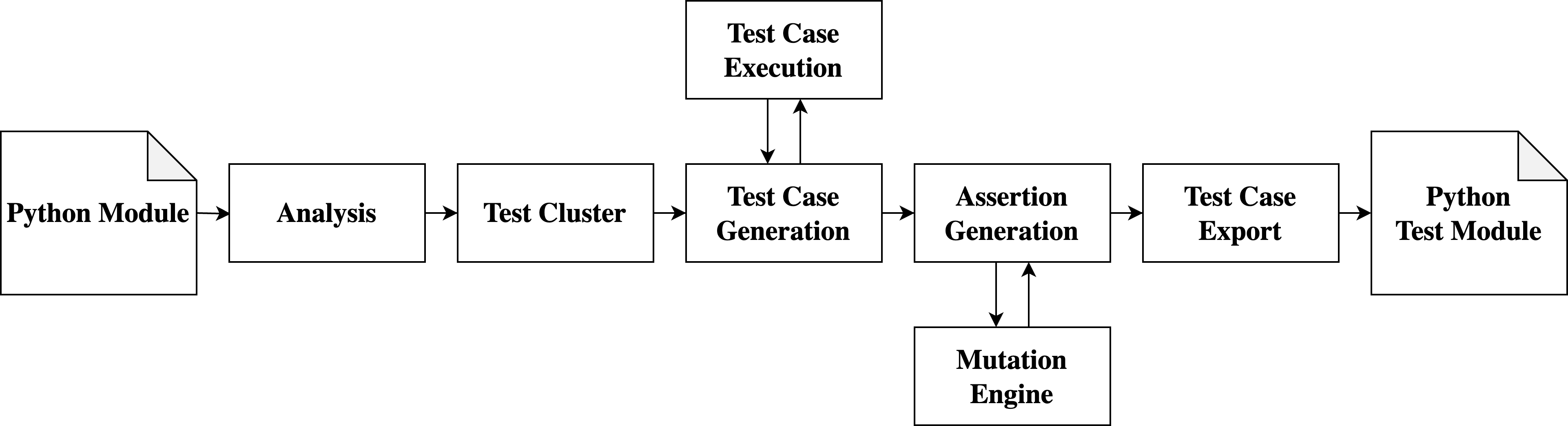
Python Module
Pynguin takes as input a Python module. Usually, a module in Python is equivalent to a source file.
Analysis
Pynguin then analyzes the module to extract information. The extracted information consists, among others, of the declared classes, functions, and methods. From this information, Pynguin builds the so-called test cluster.
Furthermore, Pynguin inspects the modules that are transitively included by the module under test.
From the context, Pynguin extracts the types they define by searching for those class definitions that are available in the namespace of the module under test. These types are then used as input-type candidates during the test-generation phase.
The entry point for this analysis is the pynguin.analyses.module.analyse_module().
The pynguin.analyses.typesystem.TypeSystem and the pynguin.analyses.typesystem.InferredSignature classes handles the inference of parameter and return types based on the analysis and other information gained during Pynguin execution.
Test Cluster
The test cluster contains all information about the module under test, most importantly, which classes, functions, and methods are declared, and what their parameters are.
The pynguin.analyses.module.ModuleTestCluster class maintains a collection of accessible objects under test.
Test Case Construction
When constructing a test case, Pynguin selects a function or method from the module under test.
Afterwards, Pynguin aims to fulfill the requirements of the function’s parameters in a backwards fashion. If the function requires integer parameters (based on type annotations), Pynguin generates one to three variable assignment statements of the form var = <num> and adds them to the test case before the function-call statement. The number of integer statements as well as the generated values are chosen randomly by Pynguin, because variable values can be used for more than one parameter.
In case a more complex object is required as a parameter, Pynguin will attempt to generate it by recursively fulfilling the parameters of the involved methods; the necessary statements are also prepended to the list of statements of the test case.
Pynguin then uses an genetic algorithm, such as for example the DynaMOSA algorithm, to mutate, select and do crossover.
The pynguin.testcase.testcase.TestCase class represents a test case. The pynguin.ga.testcasefactory.TestCaseFactory and its subclasses are responsible for creating new test cases during the search process.
Test Case Execution
Pynguin then executes the newly generated test cases against the module under test to measure the achieved coverage by instrumenting Python’s byte code on-the-fly to trace which parts of the module under test have been executed by a generated test.
It then continues with the next iteration of the test-generation algorithm. This process stops once a configurable stopping condition is satisfied.
The pynguin.testcase.execution.TestCaseExecutor class is responsible for executing test cases. The pynguin.instrumentation.tracer.ExecutionTracer handles the instrumentation and tracing of code execution during test runs.
Ignoring Code: The pynguin.configuration.Configuration.ignore_methods and pynguin.configuration.Configuration.ignore_modules options create a blacklist that prevents analysis and inclusion in the test cluster.
This is useful for code that should not be executed, but not suitable for code that should be omitted as a coverage goal.
Fitness Function: The pynguin.ga.computations.FitnessFunction class is responsible for evaluating the fitness of generated test cases:
The
pynguin.instrumentation.tracer.ExecutionTracerinstruments conditional jumpsFor equality comparisons, Levenshtein distance is used
For Strings comparison character distance based on left-aligned strings is used
Assertion Generation
After the test case generation, Pynguin optionally attempts to generate regression assertions to not only execute the code under test but also check its results. The approach implemented in Pynguin is based on mutation testing.
Mutation Engine
The generated tests are executed against generated mutants as well as the original module. By tracing the values of object attributes and function returns, Pynguin determines which values change on the mutated version, compared to the original module. For these values, Pynguin generates assertions that interpret the returned values on the original module as the ground truth.
Important classes for Mutation are:
pynguin.assertion.assertiongenerator.MutationAnalysisAssertionGeneratorwhich coordinates the mutation processpynguin.assertion.mutation_analysis.controller.MutationControllerthat creates mutantspynguin.assertion.mutation_analysis.mutators.FirstOrderMutatorthat applies mutations to the code
Further Implementation Details
In the following you can find an incomplete list of more specific implementation details.
Dynamic Seeding
Dynamic seeding helps Pynguin generate effective test inputs by collecting values from the code under test.
Instrumentation: The pynguin.instrumentation.version.DynamicSeedingInstrumentation class:
Instruments comparison operations
Adds values from both sides of equality comparisons
Handles string operations like
.endswith()and.startswith()
Type Tracing
Pynguin requires a second test execution, but allows for refining parameter types:
First execution: For regular results
Second execution: With proxies to refine parameter types
The
pynguin.testcase.execution.TypeTracingObservermonitors execution to collect type informationIt creates
pynguin.utils.typetracing.UsageTraceNodeobjects to store the traced type information (based on type checks, argument types and child nodes in the execution tree)pynguin.analyses.typesystem.InferredSignature.get_parameter_types()methods update guesses based on usage traces
Master-Worker Architecture
The master-worker architecture provides fault-recovering execution model for Pynguin’s test generation process. It isolates the core test generation logic into a separate worker process, which is managed and monitored by a master process. This prevents the main Pynguin application from crashing if the test generation process fails unexpectedly (e.g., due to a segmentation fault during threaded execution) and allows for automatic restart (no recovery) of test generation.
Components
PynguinClient
This is the main public interface. It simplifies the interaction with the
master-worker system. The client is responsible for starting and stopping the
MasterProcess and submitting the initial test generation task.
MasterProcess
This is the central coordinator. It manages worker processes as RunningTask instances.
RunningTask
A RunningTask represents a test generation task in its own worker process.
It is responsible for:
Restarting the worker process if it crashes.
Automatically adjusting the configuration (e.g., remaining search time) after a worker crash.
Enabling the more robust subprocess execution mode within the worker if a crash occurs.
worker_main
This function runs in a separate, dedicated process. It executes run_pynguin
with the provided configuration and returns the results back to the master.
Workflow
A
PynguinClientis created, which in turn initializes aMasterProcess.The client starts the master with a given configuration for test generation.
The
MasterProcesscreates aRunningTaskwhich starts a worker with aWorkerTaskas subprocess for the provided configuration.The worker executes the
WorkerTask.If the worker crashes, the
RunningTaskstarts a newWorkerTaskwith an adjusted configuration (reduced search time, subprocess execution).Upon completion, the worker sends a
WorkerResultback to theRunningTask, which returns it to theMasterProcess.The client retrieves this result from the master and returns the
ReturnCodeof the Pynguin execution.